Hagerman's Vulture Skull overdrive gives a TV tube two jobs
A new-old-stock 6U8A TV tube feeds a triode gain stage into a pentode clipping stage, and a Boost switch pushes that pentode into saturation.
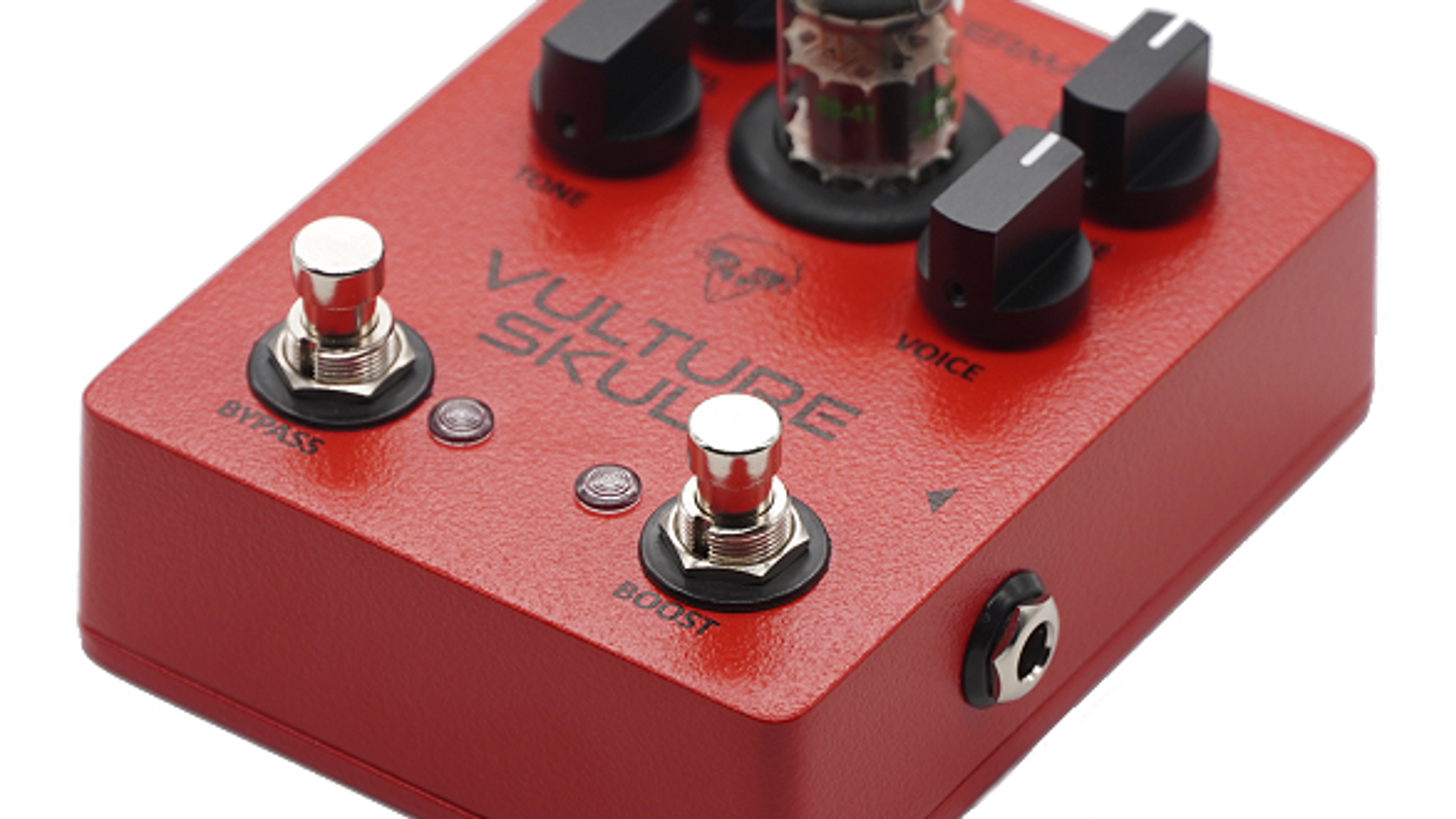
Where you would expect a 12AX7, there is a television tube. Hagerman Amplification's Vulture Skull runs on a new-old-stock 6U8A, which the maker describes as a vintage TV tube, and the circuit gives it two jobs: a triode gain stage followed by a pentode clipping stage. Hence Hagerman's own line that this is not your father's 12AX7 overdrive pedal.
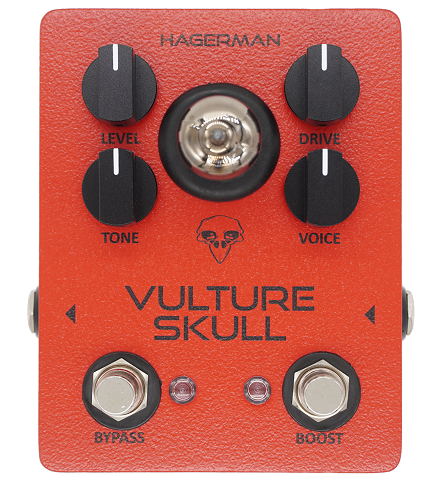
Those two stages map onto two footswitches, Bypass and Boost. Hagerman pitches the clean side as a preamp for warming up harmonics or, in its words, de-sterilizing a digital rig. In Boost mode the Voice and Drive controls are ground-lifted and the pentode is pushed into saturation, which the maker says gives an overdrive channel with plenty of tube feel, sag and bloom.
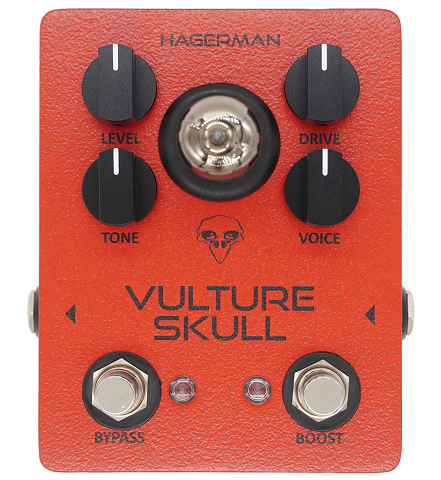
Voice and Drive sit between the triode and the pentode, with Tone and Level after the clipping stage. The manual suggests starting with every control at noon. The designer's own routine is to set Tone in Boost mode first, then Voice in clean mode.
The 6U8A is not the only option. Hagerman lists the 6EA8, 6AN8A, 6LN8, 6JW8, 6KD8 and 6GH8A as tubes the pedal also operates with. A 66V tube supply comes from a 9V centre-negative adapter, with the pedal drawing 380mA, and it needs about 30 seconds to warm up to full power. The rest of the listed spec: true bypass, 50Hz to 8kHz bandwidth, 230k ohm input impedance, and 4.7 by 4.0 by 3.1 inches with the tube fitted.
Every Hagerman product is hand-built to order in the USA, and the maker's wait times page says typical waits are a week or less at the moment. The full description and manual are on the Vulture Skull page at Hagerman Amplification, and the specs are collected on our Vulture Skull page.